
A Quick Primer on Hydronic Systems
Hydronic systems are heating or cooling systems that use either water or a water/glycol mix to move heat throughout a building as opposed to air. The water is heated at a central source, runs through an elaborate network of pipes to terminal, or emitter, components. Depending on the setup, these could be radiators, baseboard units, air handlers, or radiant floor tubing. A pump keeps the water moving, and after the heat is released, it returns to the source to be reheated and recirculated. Heat and repeat.
Heat is generated from various sources. For conventional systems, it comes from either gas-fired, oil-fired, or electric boilers. Newer generation systems rely on lower-carbon methods such as air-to-water or ground-source heat pumps, as well as solar thermal arrays.
Water holds and transfers heat more efficiently than air does. As a result, they run quieter and heat more evenly than alternative approaches. However, the efficiency of the system ultimately depends on how well the heat source’s output matches the building’s demand at any given moment. This is where it starts to get tricky.
What a Buffer Tank Actually Does
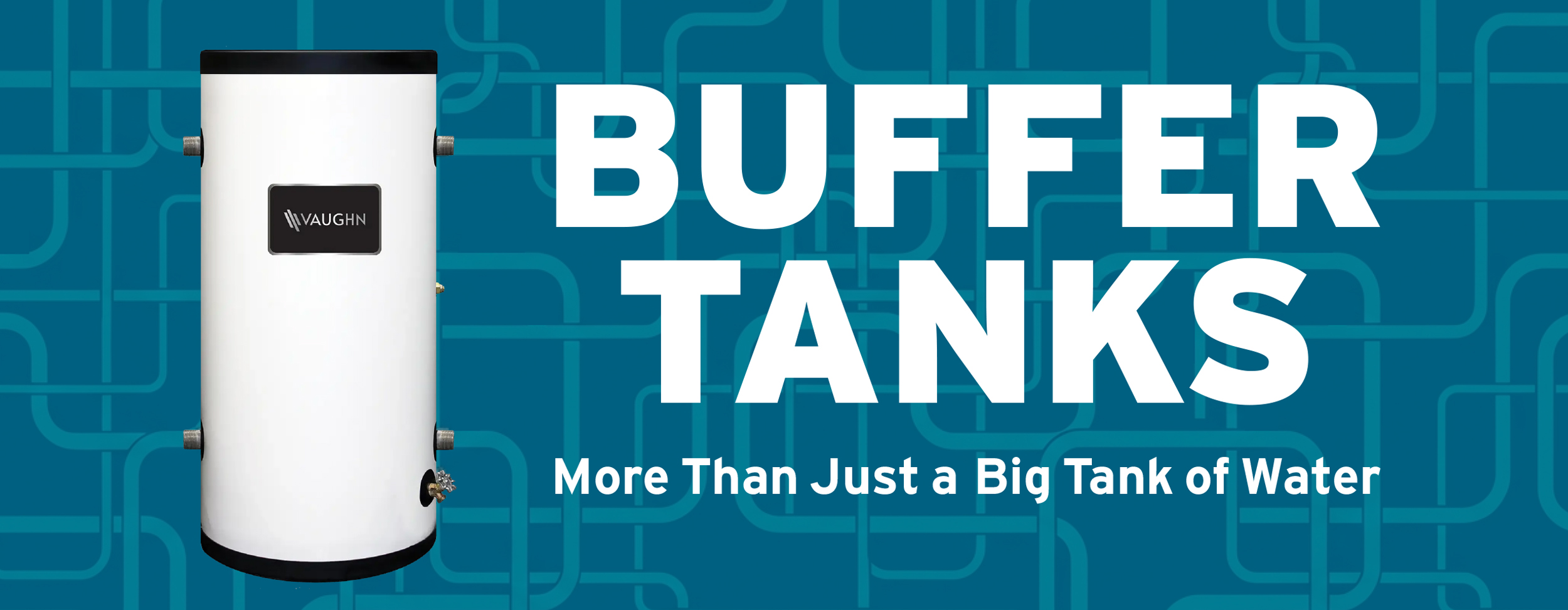
A buffer tank is an insulated storage vessel that lives between the heat source and the distribution system. It serves as a reservoir for hot water to make up for the mismatch between how fast the source is producing heat, and how fast the building demands it.
It’s important to note that boilers and heat pumps are most efficient when they run in long, steady cycles. In reality, heat loads will fluctuate throughout any given day. On mild, low demand days, modern high-efficiency units can easily supply what the building calls for. But when demands spike , the heat source is forced to turn on and off rapidly. This is known as short-cycling. It’s annoying and costly. Each startup gobbles up extra fuel or electricity and accelerates system component wear.
Enter the buffer tank! Its role is to absorb extra heat during a firing cycle, store it, and release it gradually when the load calls for it. This allows the heat source to run longer, fire less frequently, and run more efficiently.
Additional Buffer Tank Benefits
Besides performing the primary function of reliably fulfilling fluctuating heat demands, buffer tanks provide additional benefits. These include:
Improved Heat Pump Performance - buffer tanks reduce the stress on heat pumps allowing them to run more efficiently and have longer lifespans.
Increased System Flexibility - buffer tanks make it easier to combine multiple heat sources such as a gas boiler and heat pump paired with solar thermal. Each can add heat to the same reservoir independent of what’s being distributed at a particular moment.
Hydraulic Separation - buffer tanks can also double as a hydraulic break between the boiler loop and distribution loop. This simplifies pump sizing and prevents flow interference between zones with varying flow rates.
Domestic Hot Water Support - a buffer tank can also be fitted with an internal coil or external plate heat exchanger to help supply domestic hot water.
Conclusion
Buffer tanks aren’t exactly glamorous. But they are one of the simplest and cost-effective ways to improve performance and efficiency, while protecting equipment and bringing flexibility to a hydronic system.